

Last updated: August 9, 2026
A trust you're a beneficiary of just sent you a form titled "Schedule K-1 (Form 1041)." It's covered in boxes and codes, it landed in your inbox weeks after you'd stopped thinking about the trust, and now you're staring at it wondering whether you owe money, whether you're in trouble, and what on earth you're supposed to do with it.
Take a breath. A K-1 is not a bill, and it's not a sign you did anything wrong. It's an information form: the trust's way of telling you (and the IRS) how much of the trust's income is now your responsibility to report on your personal tax return. This guide walks through what the form actually says, which box goes where on your 1040, and the few things Texas beneficiaries specifically need to watch.
What a Trust K-1 Actually Is
When a trust earns income - interest, dividends, capital gains, rent - and then distributes some or all of it to beneficiaries, the tax bill on that income generally follows the money. The trust files its own return (Form 1041) and takes a deduction for what it paid out. That distributed income doesn't vanish; it gets passed to you, the beneficiary, to report and pay tax on at your own rate.
The Schedule K-1 is the document that carries that income from the trust's return to yours. Think of it the way you think of a W-2 from an employer or a 1099 from a bank: someone else calculated a number, reported it to the IRS, and sent you a copy so your return matches theirs. The trustee prepares your K-1, files a copy with the IRS as part of Form 1041, and gives you your copy.
The key idea is that the character of the income is preserved. If the trust earned qualified dividends, they land on your return as qualified dividends. If it had long-term capital gains, they stay long-term capital gains for you. The K-1's boxes exist precisely to keep each type of income in its own lane so it's taxed correctly on your side.
Reading the Boxes: Where Each Number Goes
The most useful thing you can do is stop reading the K-1 top to bottom and instead match each filled-in box to the right line on your 1040. Most trust K-1s only have two or three boxes with numbers in them. Here's what the common ones mean and where they go.
| K-1 box | What it is | Where it lands on your return |
|---|---|---|
| Box 1 | Interest income | Schedule B, then Form 1040 |
| Box 2a | Ordinary dividends | Schedule B, then Form 1040 |
| Box 2b | Qualified dividends | Form 1040 (taxed at lower rates) |
| Box 3 / 4a-4c | Capital gains | Schedule D / Form 8949 |
| Box 5 | Other portfolio & nonbusiness income | Schedule 1 or the form the code points to |
| Box 9-14 | Directly apportioned deductions, credits, and coded items | Depends on the letter code in the box |
Boxes 9 through 14 are where people get stuck, because each entry has a letter code, and the code (not the box number) tells you where the amount belongs. The IRS "Instructions for Schedule K-1 (Form 1041)" include a code table that translates every letter into a destination line. Don't guess at these. Look up the specific code, because two amounts sitting in the same box can go to completely different places on your return.
One box deserves special attention: Box 14, Code B (foreign taxes), along with the final-year codes. If the trust terminated during the year, it may pass out excess deductions or unused loss carryovers to you in its final year. Those can be genuinely valuable, but only if you know to claim them.
It also helps to sanity-check the K-1 against what you actually experienced. If you know the trust holds a rental property but Box 5 and its rental code are blank, or you received a large check but every box shows a modest number, that mismatch is worth a question to the trustee before you file. K-1s are prepared by people, and a corrected K-1 issued after you've filed means an amended return on your end. A five-minute call up front ("does this reflect the full year, and is anything still being finalized?") is cheaper than fixing it later. Keep the K-1 with your tax records for the year; if the IRS ever asks about a number, the form is your documentation.
The Texas Angle: No State K-1, but Watch Your Own Return
Here's the good news if you live in Texas: there is no state personal income tax, so there's no Texas equivalent of the K-1 to file and no state income tax on the trust income flowing to you. That's one fewer form than a beneficiary in California or New York deals with.
But two things still catch Texas beneficiaries off guard. First, the trust itself may not be a Texas trust. If the trust is administered in another state, or holds real estate or a business operating in a state that does tax income, that state can still reach the income, and you may owe a nonresident return there even though you never leave Texas. The K-1 or an attached statement usually flags this; a state column or a footnote naming another state is the tell.
Second, community property rules can matter for married Texas beneficiaries in specific situations, particularly when the interest in the trust was acquired during the marriage or funded with community assets. That's a narrower issue, but it's exactly the kind of Texas-specific wrinkle a national tax-prep chain tends to miss. If your K-1 income is substantial and you're married, it's worth a second look.
Common Mistakes Beneficiaries Make
The errors we see most often aren't complicated. They're just easy to make when a form shows up unannounced.
Ignoring it because "I didn't get any cash." Some trusts distribute income on paper without cutting you a check, or distribute in a later year. If the K-1 has numbers on it, the IRS has a matching copy, and those numbers belong on your return regardless of whether cash hit your account.
Filing before the K-1 arrives. Trust returns are often prepared later than individual returns, and K-1s can arrive in late March or even after an extension. Filing your 1040 early and then getting a K-1 means an amended return. If you know you're a beneficiary of a trust that hasn't sent your K-1, it's usually smarter to extend.
Reporting the gross distribution instead of the K-1 amounts. You report what's in the boxes, the taxable income by type, not the total dollar amount the trust sent you. A large distribution can carry a small amount of taxable income, or vice versa. The boxes are the source of truth.
Skipping the codes. As noted above, the letter codes in the higher boxes drive where amounts go. Entering them in the wrong place is the most common reason a beneficiary's return doesn't match the IRS's records.
The table below sorts out who owes what, because that's the question underneath all the anxiety.
| Situation | Who reports the income | What you do |
|---|---|---|
| Trust distributed its income to you | You (the beneficiary) | Report each K-1 box on your 1040 |
| Trust retained the income | The trust | Nothing, since you have no K-1 for it |
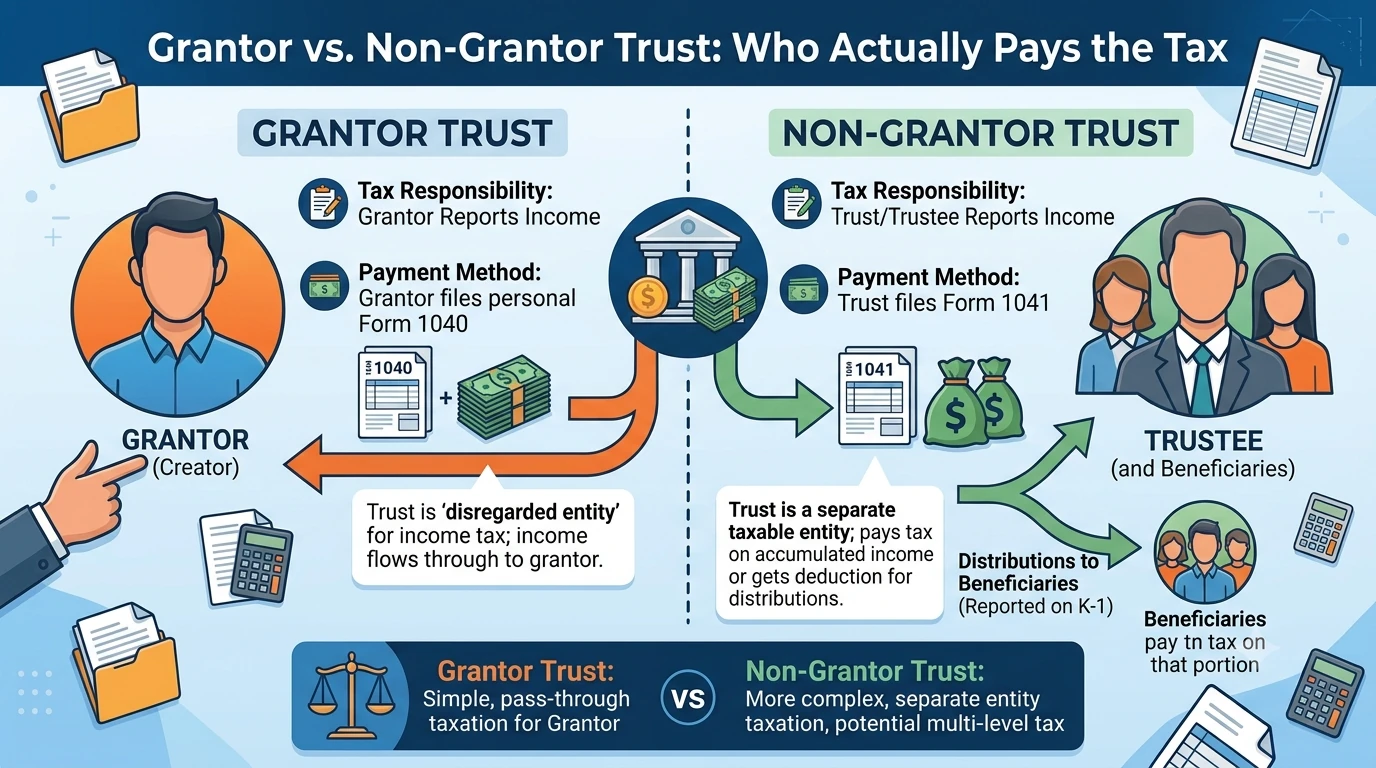
| Grantor trust (someone else is the owner) | The grantor | You may get a grantor letter, not a standard K-1 |
| Trust's final year with excess deductions | You | Claim the passed-through deductions/carryovers |
Not sure your K-1 is on your return correctly?
We'll match every box on your trust K-1 to the right line on your 1040 and flag any codes worth a second look before you file.
The Bottom Line
A trust K-1 looks intimidating, but it's doing one simple job: telling you which slices of the trust's income are now yours to report. Match each numbered box to the right line on your 1040, respect the letter codes in the higher boxes, and don't file until the form is actually in hand. For a Texas beneficiary, there's no state return to worry about. Just make sure another state hasn't quietly attached itself through where the trust operates or invests.
If the numbers are large, the codes are unfamiliar, or the trust hit its final year, that's the moment a quick review with a CPA pays for itself. Catching a passed-through deduction or a lower capital-gains rate usually saves more than the review costs. If you'd like a set of eyes on your K-1 before you file, we're happy to help you read it correctly the first time.