
Last updated: November 10, 2026
Your P&L says the business made money last year. A good amount, maybe. And yet the bank balance is about where it was in January, and you are not sure where the difference went.
That question has an answer, and it is almost always sitting on the second report in your accounting software, the one most owners skip. The P&L tells you whether you made money. The balance sheet tells you where the money is now. If you already read your P&L with some confidence, and our guide to reading a profit and loss statement covers that half, this is the other half.
What a balance sheet is, and why it is not the P&L
A P&L covers a period of time: a month, a quarter, a year. It adds up what came in and what went out and tells you the difference. A balance sheet covers a single moment. It lists what the business owns, what it owes, and what is left over for the owners, as of one date.
Everything on it follows one equation: assets = liabilities + equity. What the business owns was paid for either with someone else's money (liabilities) or with the owners' money and retained profit (equity). That is why it balances, and why a balance sheet that does not balance means something is broken in the books.
| Profit and loss statement | Balance sheet | |
|---|---|---|
| Time covered | A period (month, quarter, year) | A single date |
| Main question | Did we make money? | Where is the money, and what do we owe? |
| Resets each year | Yes, income and expenses start again at zero | No, balances carry forward |
| What it hides | Cash tied up in customers, stock, and debt | Whether the period was profitable |
The two reports are connected. Each year's profit flows into equity on the balance sheet. So if the P&L is right and the balance sheet is wrong, or the reverse, the two will eventually disagree in a way someone has to explain.
Profit is not cash: where the money went
This is the question owners bring to us most often, so take a hypothetical business. A Houston-area wholesale supplier with 18 employees, on the accrual method, finishes the year with $240,000 of profit on its P&L. Its bank balance went up by $9,000. Here is where the other $231,000 went.
| What happened during the year | Effect on cash | Where it shows on the balance sheet |
|---|---|---|
| Profit for the year, per the P&L | +$240,000 | Equity, as retained earnings |
| Customers owe more at year-end than they did in January | -$70,000 | Accounts receivable, up |
| More stock on the shelves than a year ago | -$45,000 | Inventory, up |
| Loan principal paid down | -$36,000 | Loan balance, down |
| Distributions to the owners | -$80,000 | Equity, distributions |
| Net change in the bank balance | +$9,000 | Cash, up |
None of those four outflows is an expense, which is why none of them appears on the P&L. Revenue was recorded when the invoices went out, but $70,000 of it has not been collected. Inventory is not an expense until it is sold, so stock that is still on the shelves is cash converted into an asset. Loan principal reduces a liability rather than hitting profit; only the interest is an expense. And money paid to owners comes out of equity, not out of profit.
Every one of those items is visible on the balance sheet, and none of them is visible anywhere else. That is the whole case for reading it. On the cash method, the receivables line works differently, because uncollected invoices are not counted as income yet. Our cash vs. accrual guide explains how that changes the picture.
Assets: where your money is tied up
Assets are listed roughly in order of how quickly they turn into cash. The top of the list is what matters most for a growing business.
Cash should match your bank and card statements as of the balance sheet date, to the dollar. If it does not, nothing below it can be trusted yet. Accounts receivable is money customers owe you. A rising balance can mean growth, or it can mean customers are paying slower; the aging report tells you which. Inventory is cash you have already spent on product you have not sold. For businesses that carry stock (a distributor, say, or a retailer or restaurant), it is often the largest asset after cash, and the hardest one to keep accurate. Our post on restaurant bookkeeping shows how much depends on counting it properly.
Further down sit fixed assets: vehicles, equipment, buildings. These are recorded at cost and reduced over time by depreciation, so the balance sheet figure is a bookkeeping value, not what the truck would sell for. The tax return may treat the same purchase differently from the books, which is one more reason the two need to be reconciled by someone who prepares both.
Liabilities: what you owe, and when
Liabilities are split into current, meaning due within the next twelve months, and long-term. That split matters more than the totals.
Current liabilities include vendor bills and credit card balances, plus the part of any loan due in the coming year. They also include money you are holding for someone else. Sales tax you collected belongs to the Texas Comptroller. Payroll taxes withheld from employees' checks belong to the IRS. Those balances look like cash in your bank account, but they are not yours, and unpaid payroll withholding in particular can become the owner's personal problem rather than just the company's.
Long-term liabilities are mostly loans and longer-term lines of credit. Sometimes they include money the owner has lent to the business. The question to ask of every loan line is simple: does it match the lender's statement? If it does not, the most common reason is that payments were recorded as an expense in full instead of being split between principal and interest.
Equity: the owner's line
Equity is what would be left for the owners if every asset were turned into cash at book value and every liability paid. It starts with what owners put in, adds the profit kept over the years, and subtracts whatever owners took out.
Depending on the entity, what owners took out shows up as draws or as distributions, and either way it reduces equity, not profit. This is where personal spending through the business card tends to surface, and where the owner's own money gets tangled up. A shareholder loan, a contribution, and a distribution are three different things with three different consequences, and the books need to say which one happened.
Negative equity is the line to watch. It means the business owes more than it owns at book value, usually because owners have taken out more than the business earned and kept. For some entities that has tax consequences, so it is worth raising with your CPA rather than leaving as a curiosity.
Three checks worth a minute every month
You do not need to analyze the whole report every month. These three checks catch most of what goes wrong.
| Check | How to read it | What a warning looks like |
|---|---|---|
| Cash vs. the bank statement | The balance sheet cash figure should equal the reconciled bank balance on the same date | Any difference, because everything else depends on this line |
| Current assets ÷ current liabilities | Above 1 means short-term resources cover short-term obligations | Below 1, or falling month after month |
| Days to collect | Receivables ÷ (annual revenue ÷ 365), compared with your payment terms | Collection time drifting well past your terms |
The first is about whether the report is accurate. The second and third are about whether the business can pay its bills on time while it grows. A business can be profitable and still fail the second test, which is exactly the situation the opening question describes.
From reading it to planning with it
Reading the balance sheet tells you where the cash went. Planning with it tells you where the cash will be. That is a different exercise: a forecast of collections, inventory purchases, loan payments, payroll, and owner distributions over the coming weeks and months. Our 13-week cash flow forecast case study shows what that looks like in practice, and if you are wondering whether your business has reached that point, our post on whether you need a CFO is a reasonable place to start.
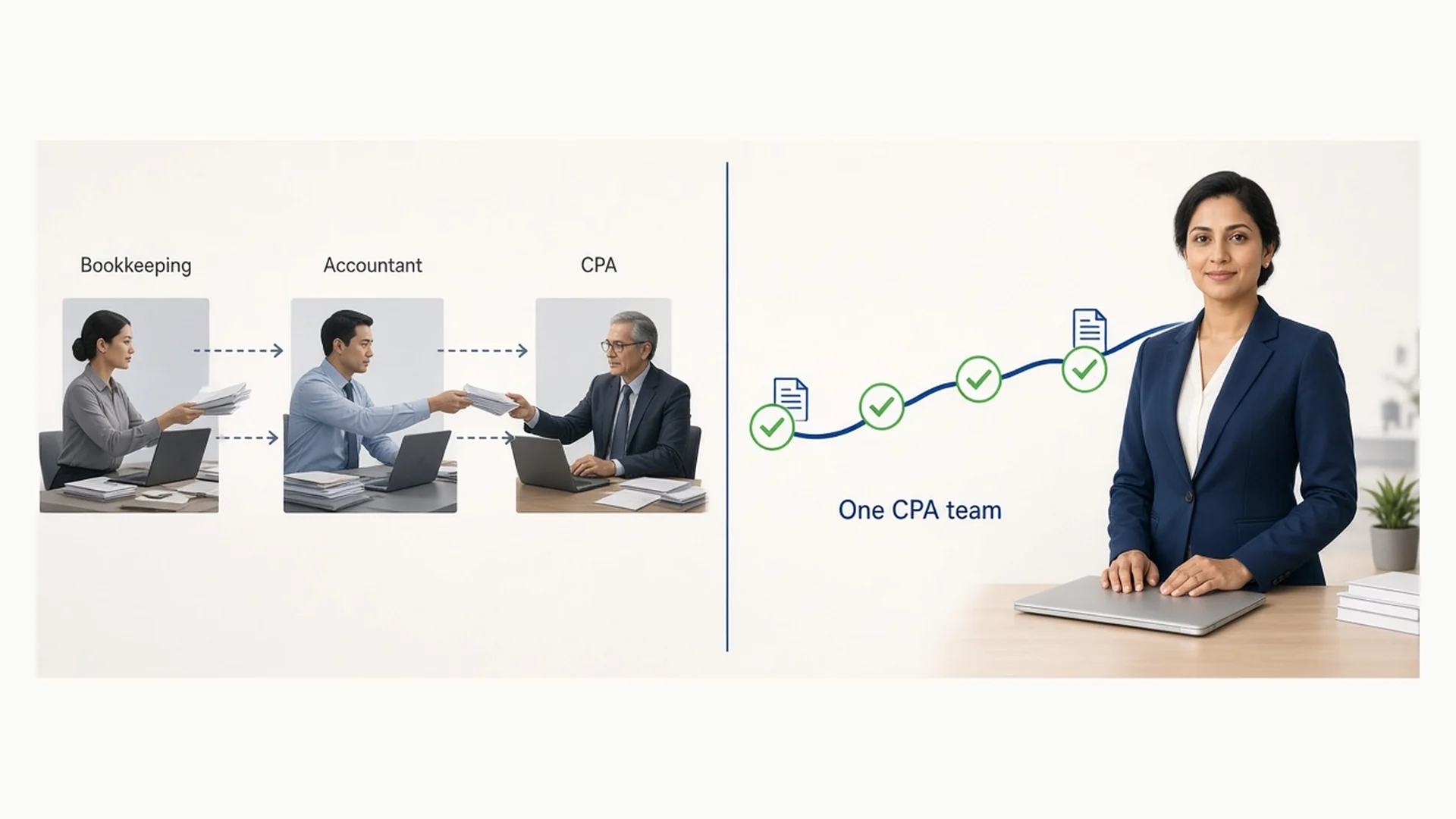
Either way, it depends on a balance sheet you can trust. Most of the lines above are only as good as the reconciliations behind them, which is why we keep the books ourselves for full-service clients rather than working from whatever arrives at year-end. The same team that reconciles the balance sheet prepares the return and builds the forecast, so nobody is waiting on a third party to explain a number. If you are deciding who should be doing which part of that work, our guide to the difference between a bookkeeper, an accountant, and a CPA lays it out.
Profit on paper, but not in the bank?
We'll reconcile the accounts behind your balance sheet, walk you through it line by line, and show exactly where last year's profit went.
The Bottom Line
The P&L tells you whether the business made money. The balance sheet tells you where that money is now: in customers' hands, on the shelves, paid to the bank, or paid to the owners. When profit and cash disagree, the answer is almost always in the changes to receivables, inventory, debt, and owner distributions, and none of those appear on the P&L. Read assets for what is tied up and liabilities for what is due and when. Equity shows what the owners have put in and taken out. Check three things monthly: that cash matches the bank, that current assets cover current liabilities, and that collections are keeping pace with your terms. Once you can trust the balance sheet, it stops being a look backward and becomes something you can plan with.