
Last updated: October 16, 2026
Many business owners are on one of these two methods without ever having chosen it. The software defaulted to something, or a previous preparer checked a box on the first return, and it has been carried forward every year since. That is usually fine. It is also one of the more consequential tax settings in your business, and it is worth understanding which one you are on and whether it still fits.
The difference, in one example
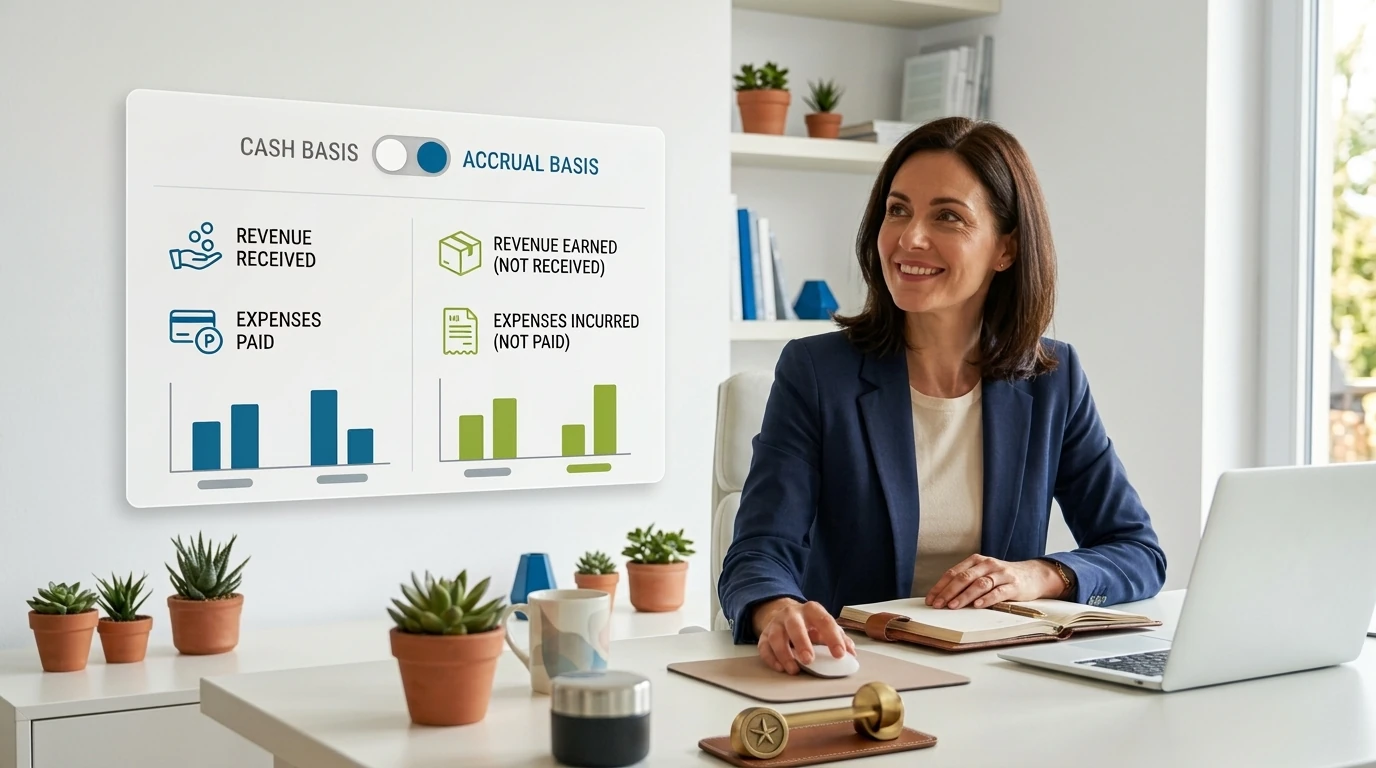
Cash accounting records income when money arrives and expenses when money leaves. Accrual accounting records income when you earn it and expenses when you incur them, regardless of when the cash moves.
That sounds abstract until you watch a single December transaction land in two different tax years.
Say you finish a $20,000 project in December 2026, invoice it on December 15, and the client pays on January 12, 2027. In the same month, a subcontractor bills you $8,000 for their part of the work, and you pay that bill on January 5.
| Cash method | Accrual method | |
|---|---|---|
| The $20,000 invoice | Income in 2027, when paid | Income in 2026, when earned |
| The $8,000 subcontractor bill | Expense in 2027, when paid | Expense in 2026, when incurred |
| Net effect on 2026 taxable income | $0 | $12,000 |
| Net effect on 2027 taxable income | $12,000 | $0 |
Same work, same client, same cash. The only thing that changed is which year the profit is taxed in. Over a business's life the totals even out, but in any given year the difference can be large, and timing is where a lot of practical tax planning lives.
Which method are you on right now?
The answer is on your last return. A sole proprietor's Schedule C has a checkbox for it on line F. S corporations answer the same question on Schedule B of Form 1120-S, partnerships answer it in Item H on page 1 of Form 1065, and C corporations answer it in question 1 of Schedule K on Form 1120. Whatever was checked there is your method, and you are expected to keep using it consistently until you formally change it.
Your books and return can differ, but only if someone reconciles them. If your accounting software is producing accrual reports and the return says cash, someone is converting between the two at year-end, and you should know who and how. If nobody is, the return and the books may not match, which tends to surface at an inconvenient moment.
Who has to use accrual
For most small businesses, cash is allowed. The restriction is narrower than many owners assume.
The main federal limit sits in section 448 of the tax code. C corporations, and partnerships that have a C corporation as a partner, can only use the cash method if they pass a gross receipts test. For tax years beginning in 2026, that test is average annual gross receipts of $32,000,000 or less over the prior three tax years. The figure is indexed for inflation and changes most years, so check the current number rather than relying on a past one. Related businesses under common control are generally counted together for this test.
| Business type | Can use cash method? |
|---|---|
| Sole proprietor, single-member LLC | Generally yes, regardless of size |
| S corporation | Generally yes, regardless of size |
| Partnership with no C corporation partners | Generally yes, regardless of size |
| C corporation, or partnership with a C corporation partner | Only if average gross receipts are $32,000,000 or less (2026) |
| Qualified personal service corporation | Yes, regardless of size |
| Any business with inventory and gross receipts over $32,000,000 | Accrual required for inventory purchases and sales |
| Tax shelter, as the code defines it | No, regardless of size |
One exception matters for professional firms. A qualified personal service corporation can use the cash method at any size. That means a C corporation whose work is substantially all in health, law, engineering, architecture, accounting, actuarial science, performing arts, or consulting, and whose stock is held mainly by the people doing that work. Farming businesses are also exempt.
The same gross receipts test also governs inventory. Businesses that pass it can generally skip formal inventory accounting and treat inventory as non-incidental materials and supplies, or follow the method used in their books. That relief is what lets many small product businesses stay on a cash or near-cash approach. Businesses above the threshold that carry inventory must use accrual for their inventory purchases and sales, whatever their entity type. They can still use cash for everything else.
Which one is right for a small business
Neither is better in the abstract. They answer different questions.
| Cash | Accrual | |
|---|---|---|
| Simplicity | Simpler. Your bank activity drives the books | More work: receivables, payables, and accruals to track |
| What profit tells you | What came in and went out | What you actually earned and owed in the period |
| Tax timing control | More, since billing and payment timing move income between years | Less, since income is recognized when earned |
| Fit for lenders and investors | Weaker; many want accrual statements | Stronger, and required when a lender asks for GAAP financial statements |
| Typical fit | Service businesses, consultants, small firms paid close to delivery | Businesses with inventory, long receivable cycles, or outside financing |
For a small service business paid within a few weeks of doing the work, cash is usually the practical choice. Its tax advantage depends on how much is still unpaid at year-end. Where cash starts to mislead is a business with large receivables or payables. A month where you invoiced heavily but collected little looks like a loss on a cash basis when it was actually your best month. The reverse is just as possible.
You do not have to pick one view for everything. Plenty of businesses file on the cash method while reviewing accrual-basis reports internally, so they see real profitability without giving up the tax timing. The reconciliation between the two is part of the year-end work, and it should be someone's explicit job.
Why this is a planning decision, not a software setting
On the cash method, timing near year-end is a real lever. Billing in January rather than December usually delays the payment, and the income, into the next year. Paying January's bills in December pulls those deductions forward. Both are legitimate, within limits.
The limits matter. Income you have the right to and could take is generally treated as received under the constructive receipt doctrine, even if you leave the check in a drawer. Prepaying expenses only helps within the IRS's 12-month rule. And deferring income is only worth doing if it fits the bigger picture, since next year's rate or an entity change may make this year the better one to recognize it.
That is why the method belongs in the planning conversation rather than the software defaults. It interacts with entity choice and, for an S corporation, with reasonable compensation. It affects estimated tax payments. In Texas it also reaches your franchise report, since the revenue figures on that report generally flow from what is reported on your federal return. A method someone chose by accident years ago is probably still fine. It is just worth knowing why.
Not sure which method your business is actually on?
We will pull your last return, confirm the method you are really using, and tell you whether it still fits how your business gets paid.
The Bottom Line
Cash accounting records income and expenses when money moves; accrual records them when they are earned and incurred. The difference does not change your lifetime income, but it changes which year it is taxed in, and a single December invoice can shift a meaningful amount of profit across that line. Most sole proprietors, S corporations, and partnerships without corporate partners can use cash regardless of size. C corporations and partnerships with C corporation partners need average gross receipts of $32,000,000 or less for tax years beginning in 2026, unless the corporation is a qualified personal service corporation. Above that threshold, any business with inventory must use accrual for its inventory. Check line F on your Schedule C, Schedule B on Form 1120-S, Item H on page 1 of Form 1065, or question 1 of Schedule K on Form 1120 to see which method you are on. If it was chosen by default rather than on purpose, it is worth a deliberate look, and if you do change, it goes through Form 3115 with a section 481(a) adjustment.