Last updated: October 19, 2026
Most small businesses don't need a full-time CFO. Plenty don't need an outsourced one yet, either.
The question worth asking is narrower: are the decisions in front of you bigger than the financial support behind them? If your books are clean and current, and you're about to hire, expand, reprice, or borrow without a clear picture of what it does to cash over the next year, that's the gap a CFO fills. If your books aren't clean and current, a CFO is the wrong purchase. Fix the foundation first.
Two problems that look like one
When an owner says "I think I need a CFO," they usually mean one of two very different things.
The first is that the numbers can't be trusted. Bank accounts aren't reconciled, the month takes six weeks to close, or the reports show up and nobody believes them. That's a bookkeeping problem, sometimes a controller problem. Putting a CFO on top of it is like hiring an architect for a house with a cracked slab. The advice will be built on numbers that are wrong. If that's where you are, start with catch-up bookkeeping and a reliable monthly close.
The second problem shows up after the books are fixed. You can see last month clearly. What you can't see is next quarter. Adding two people, opening a second location, taking a contract that ties up working capital for 90 days, buying equipment, applying for a line of credit: each of these moves more money than a normal month of profit. Without a model, those calls get made on experience and gut feel. Sometimes that works. When it doesn't, it's expensive.
That second gap, the forward-looking one, is what CFO-level work exists to close.
Who does what: bookkeeper, controller, CPA, and CFO
These roles build on each other. For most owner-led businesses they come in order, and skipping a step tends to produce reports nobody uses or advice resting on bad data.
| Role | Main job | Looks at | When the need shows up |
|---|---|---|---|
| Bookkeeper | Records transactions, reconciles accounts, keeps the ledger current | What already happened | From day one |
| Controller | Owns the monthly close, controls, and accurate management reports | Whether the numbers are reliable | Once volume and moving parts increase |
| CPA | Tax compliance, tax planning, IRS representation | Compliance and after-tax results | Ongoing |
| CFO (full-time or outsourced) | Forecasting, scenario modeling, cash planning, pricing and margin analysis, financing support | What happens if you do X | When decisions get bigger and more frequent than the owner can model alone |
A bookkeeper makes sure the books are right, and a controller makes sure you can see what's happening. The CFO's job is helping you decide what to do about it. If the first two lines are blurry for you, our post on bookkeeper vs. accountant vs. CPA sorts them out.
Your CPA sits slightly to the side. A good one will flag problems and plan your taxes year-round, but filing a return and planning around it isn't the same thing as a rolling cash forecast you revisit every month.
Why profitable businesses still run out of cash
This is the part that catches owners off guard: the P&L can show a healthy profit while the bank account gets thinner every month.
It happens for ordinary reasons. Customers pay in 45 or 60 days, but payroll goes out every two weeks. Inventory has to be bought before it's sold. Growth itself eats cash, because every new customer you serve on credit is money you've spent and haven't collected yet. None of that shows up on last month's profit and loss statement, which is why reading the P&L alone isn't enough.
The research on small-business cash points the same way.
- Cash cushions are thin. The JPMorgan Chase Institute, studying hundreds of thousands of small-business bank accounts, found the median small business held about 27 days of cash. A quarter held fewer than 13 days. Restaurants sat around 16. That data is older now, but the pattern has held in later work.
- Cash flow is a top complaint. In the Federal Reserve's 2024 Small Business Credit Survey of employer firms, 75% cited rising costs as a financial challenge, 56% cited trouble paying operating expenses, and 51% cited uneven cash flows. Among firms that applied for financing, 56% said one reason was to cover operating expenses, not to grow.
- Survival is not guaranteed. Bureau of Labor Statistics data shows roughly one in five new private-sector establishments closes within its first year, and about half are gone by year five.
Running out of cash is often the final step for a business that had customers and looked profitable on paper. A forecast doesn't prevent every bad month. It gives you time to see one coming.
Signs the forward-looking work is missing
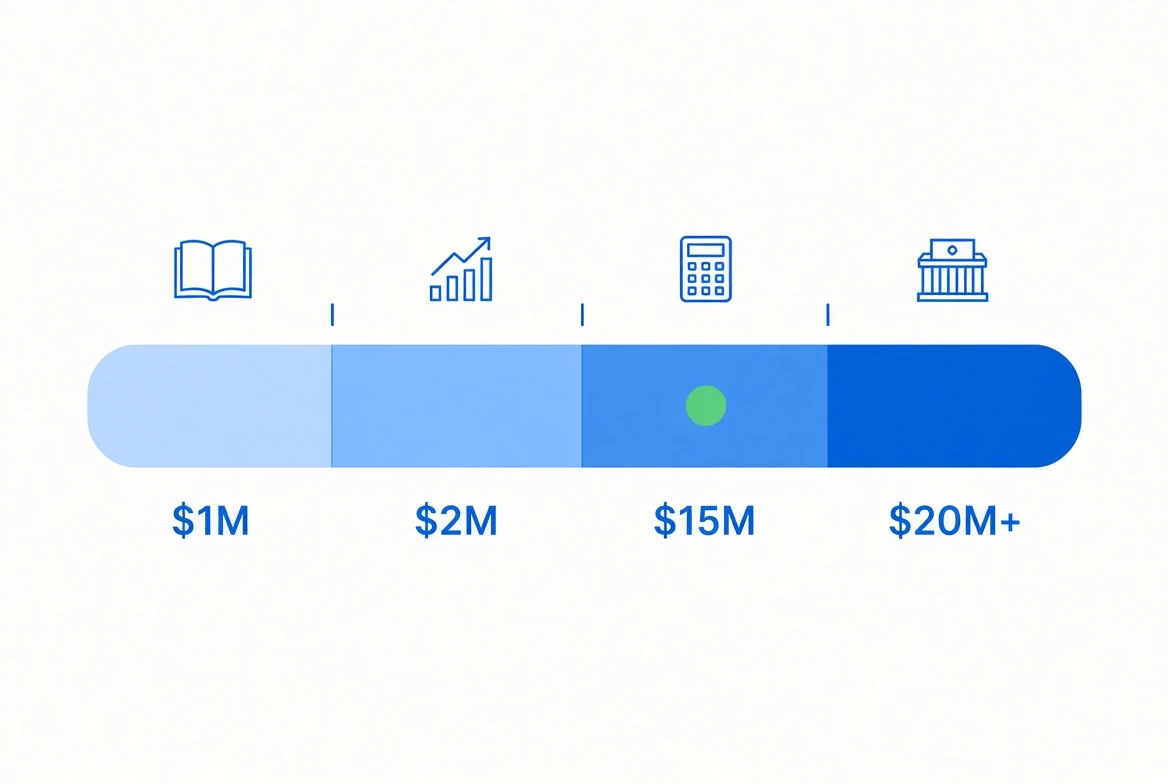
Revenue alone doesn't settle the question. What matters more is how big your next decisions are and how often they come up, plus how many moving parts the business has. Still, revenue is a useful rough guide:
| Annual revenue | What usually pays off most | CFO-level work |
|---|---|---|
| Under about $1M | Clean books and a CPA who plans year-round | Rarely worth paying for yet |
| About $1M to $2M | A reliable monthly close and readable reports | Sometimes, around a specific big decision |
| About $2M to $15M | Close plus forecasting and margin analysis | Often worth it on a part-time basis |
| Above about $15M to $20M | A finance team with daily leadership | A full-time hire starts to make sense |
Within those bands, these are the signals that tell you the gap is real:
- Cash surprises you, even in months when the P&L looks fine.
- You're about to hire, expand, change pricing, or sign a large contract, and you don't have a simple model of what it does to cash and margin.
- You can't say with reasonable confidence where cash will be in 90 days, under even two scenarios.
- Revenue is growing, but profit and cash aren't growing with it.
- A loan, a sale, a major equipment purchase, or a second location is on the horizon, and your current reports won't hold up in that conversation.
- Your bookkeeper is solid on the close but isn't set up, or doesn't have the hours, to build forecasts.
If none of these sound like you, an outsourced CFO is probably premature.
Full-time CFO vs. outsourced CFO
An outsourced (or fractional) CFO does the same senior-level work part-time, usually through a CPA firm or an independent professional. You pay a monthly retainer for a defined scope. You skip the recruiting search and the benefits load, and the engagement can scale up during a busy stretch and back down after.
| Factor | Full-time CFO | Outsourced CFO |
|---|---|---|
| Annual cost | Six figures in salary, plus bonus, benefits, and payroll taxes | A monthly retainer, usually a fraction of a full-time package |
| Time to start | Months of recruiting and onboarding | Weeks, once the books are current |
| Commitment | Permanent hire | Monthly, adjustable as needs change |
| Breadth of view | Deep in one business | Pattern recognition from many businesses of similar size |
| Best fit | Daily team leadership, constant high-stakes decisions, heavy board or investor reporting | Owner-led businesses whose big decisions come a few times a year |
A full-time hire earns its cost when strategic finance work fills most of every week: running a finance team, investor reporting, multiple entities that need constant attention. Until then, the outsourced model covers the actual need. You can see our own published range on the pricing page. It covers the advisory layer only. The bookkeeping underneath is priced separately, because the forecast is only as good as the books it's built on.
A word on labels. "Outsourced," "fractional," and "virtual" CFO get used loosely in the market, sometimes for the same service and sometimes not. Look past the label to the scope and who's actually doing the work. Then ask whether you'll get decisions out of it, or just more reports.
A six-question self-check
Answer these based on the last six to twelve months:
- Are your books closed and reconciled on a predictable schedule each month, and do you trust them?
- Without logging into the bank, could you estimate where cash will be in 90 days?
- Have you made, or are you about to make, a decision bigger than one or two months of profit without modeling its effect on cash and margin?
- Has cash been tighter than the P&L suggested more than once this year?
- Is financing, a sale, a major expansion, or a new location likely in the next 12 to 18 months?
- Is anyone currently producing a rolling forecast for you, or is that work just not happening?
If the answer to the first question is no, start there. If several of the rest are yes, the forward-looking work is probably worth buying part-time. If almost none are yes, your money is better spent elsewhere for now.
What to ask before you hire anyone
Whoever you talk to, get straight answers to these:
- What exactly will I get each month: a cash forecast, scenario models, margin analysis, a standing meeting?
- Who does the work, and have they worked with businesses my size and in my industry?
- How does this fit with my bookkeeper and my CPA? Who owns the close?
- What happens if I need more help for a few months, or less?
- Can I see a redacted example of a forecast you've built for a business like mine?
Clear answers on scope and deliverables matter more than the title on the engagement letter.
Not sure whether you need CFO-level help yet?
We can look at your books and the decisions in front of you, then tell you plainly whether a forecast, a cleaner close, or nothing new is the right next step.
The Bottom Line
You don't need a CFO because you've hit a certain size, or because another owner you know just hired one. You need CFO-level work when the cost of getting a big decision wrong is higher than the cost of the advice, and nobody on your current team can produce it.
For most owner-led businesses that reach that point, an outsourced CFO is the practical answer. For many others, the better next step is still cleaner books, a dependable monthly close, and a CPA who does more than file the return. If you'd like help figuring out which side of that line you're on, our outsourced CFO service starts with exactly that conversation.