

Last updated: October 3, 2026
"I already have a bookkeeper" is the most common reason an owner tells us they do not need a CPA. The usual answer is that a bookkeeper records and a CPA advises, so you need both. That answer is true, and it is also too comfortable, because it implies the two jobs sit side by side and hand off cleanly in the middle.
They do not hand off cleanly. The tax planning a CPA does is built on top of the recording, and the recording decisions determine which planning is still available by the time anyone looks. That is the part worth understanding before you decide who does what.
The three roles, side by side
| Bookkeeper | Accountant | CPA | |
|---|---|---|---|
| License required | No | No | Yes, by a state board |
| Title is protected | No | No | Yes |
| Typical credentials | Voluntary and software certifications | A degree, sometimes | 150 semester hours, the national exam, an experience requirement, ongoing education |
| Core work | Recording transactions accurately | Varies widely by person | Tax strategy, reporting, representation |
| Decides how transactions get structured | Follows the setup given | Sometimes | Designs the setup |
| Advises on tax strategy | No | Limited, varies | Yes |
| Signs and files business returns | No | Sometimes | Yes |
| Represents you before the IRS | No | No | Yes |
| Accountable for the position on the return | No | Rarely | Yes |
The last row drives everything else. Somebody has to stand behind what the return says, with professional standards and a license at stake. That person needs the underlying records to support it, and "support it" is a higher bar than "be accurate."
A bookkeeper is good at a genuinely hard job
Worth saying plainly, because the rest of this gets misread otherwise. Bookkeeping is skilled work and a good bookkeeper is valuable.
Keeping several hundred transactions a month categorized consistently. Reconciling every account to the statement. Chasing the receipt nobody kept, noticing that a deposit arrived net of fees, closing the month on time, every month, without drama. That is a real discipline, and most owners cannot do it themselves, which is exactly why they hire for it. Nothing below is an argument that bookkeepers are interchangeable or that the work is simple.
The argument is narrower than that. Recording accurately and recording in the shape tax planning requires are two different targets, and only one of them is a bookkeeper's job.
Bookkeeping decisions are tax decisions
Here is the part that gets missed. A transaction can be recorded correctly in several different ways, and the choice among them decides what is possible later.
| The bookkeeping choice | What it decides on the tax side |
|---|---|
| An equipment purchase expensed vs. capitalized to the asset register | Whether accelerated depreciation is even on the table, and whether the asset detail ties to the depreciation schedule |
| Owner money posted as a draw, a distribution, or an expense | Whether a reasonable-compensation position for an S-corp can be supported at all |
| Meals and entertainment in one account vs. separated | Whether the deductible portion can be claimed without re-sorting a year of transactions |
| "Professional fees" as one bucket vs. legal, accounting, and consulting split out | Whether a deduction can be substantiated line by line if anyone asks |
| Sales tracked by state vs. in total | Whether a multi-state nexus question can be answered or has to be estimated |
| Reimbursements run through an accountable plan vs. posted as compensation | Whether the money is taxable to the person who received it |
| Personal spending separated as it happens vs. untangled at year-end | The deduction, and for an LLC or corporation, a liability-protection question too |
Every row is a correct way to keep books. None of them is an error a reviewer would flag. And in every row, the left column was decided in month three by someone with no reason to be thinking about a return, while the right column gets discovered in month fourteen by someone who cannot go back and change it.
A bookkeeper is not failing when this happens. They were never given the question.
Reviewing someone else's books has a ceiling
The obvious fix is for the CPA to review the bookkeeper's work. We have done it, it beats nothing, and it has limits worth being honest about.
Review happens after the fact. By the time anyone looks at the first quarter, the quarter is closed, the vendor is paid, the asset is expensed, and the owner has already taken the money in whatever form they took it. Some of that a journal entry can fix. Some of it cannot be fixed, because the decision had a deadline attached or the supporting detail was never captured at all.
Review also only catches what it looks for. A reviewer verifies the books are right. Noticing that the books are right but shaped wrong for your situation takes detailed knowledge of your situation, which is planning work rather than review work, and by the time it surfaces in a review it is usually too late to be worth much.
Then there is the accountability gap. Two parties, each doing their own job competently, and the space between them belonging to nobody. When something surfaces at year-end, the honest answer is often that no individual made a mistake. That is worse than a mistake, because there is nothing to fix.
What our standard means in practice
So for full-service clients, where we are doing the tax planning and signing the return, we do the bookkeeping. It is the only arrangement where we can guarantee the data meets the standard the planning requires, and where there is one place to look when something is wrong. It also makes the tax work itself faster: nobody waits on a third party for answers, and every transaction follows the same accounting treatment from the first entry to the return.
Four things that standard commits to:
The chart of accounts is built backward from the return. We set it up around the decisions your situation will actually require, instead of accepting the software's default list. If you may elect S-corp status, owner activity is already separated to support it. If you operate in two states, revenue is already tracked that way. The structure exists before it is needed, which is the only time it can be built.
Every account is reconciled every month, and the month is closed and locked. Not reconciled at year-end. Not reconciled when something looks off. The monthly close is what stops a small discrepancy from compounding into a cleanup project, and locking the period is what stops corrected history from drifting again.
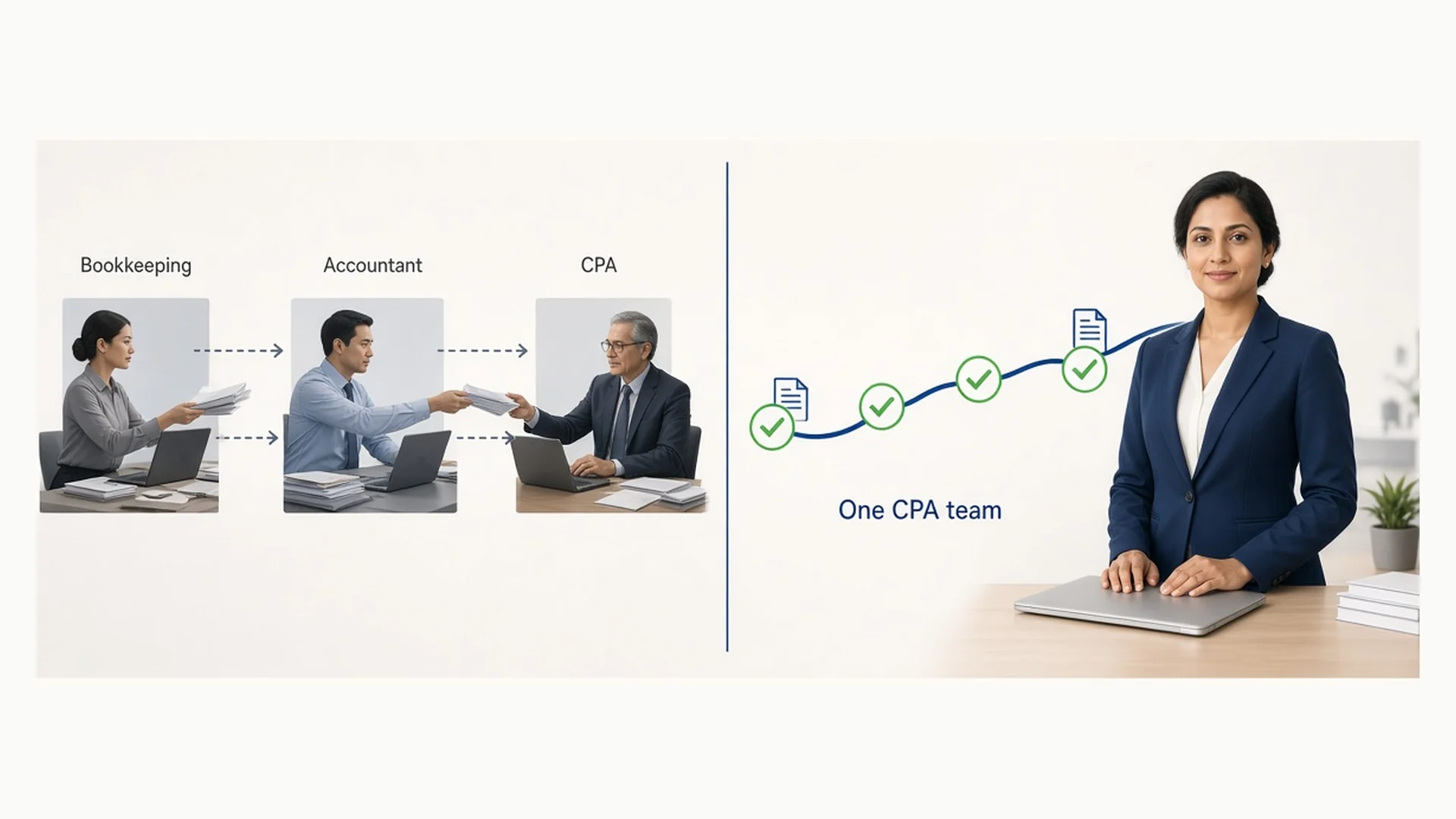
The same team owns the books and the return. The people who decided how a transaction was posted are the people who sign the return it appears on. Nobody can say that was the bookkeeper's call, because there is no bookkeeper on the other side of a handoff. Accountability sits in one place by construction.
Planning questions get raised in the month they are still answerable. When the people closing your books are the people doing your tax planning, an unusual transaction in April becomes a conversation in April. That is the whole point, and no review process replicates it.
Where the line falls for you
It depends on what you are hiring us for, and the split is clean.
If you want tax preparation only, we are fully comfortable working with whatever bookkeeping arrangement you have: your bookkeeper, your in-house person, your own spreadsheet. We will work from what you give us and tell you honestly where it limits what we can do on the return. Plenty of clients sit here and it is a legitimate place to be.
If you want tax planning and a year-round CPA relationship, we do the books as part of the engagement. Planning is what you are paying for, and it is only as good as the data underneath it. Bookkeeping approaches vary from one provider to the next, and planning needs one consistent standard, kept by the same team that signs the return.
If you already have a bookkeeper and want that second arrangement, treat it as a transition rather than a dismissal. Good bookkeepers find work quickly, and some of our clients have moved that person into an operations or receivables role where the business knowledge they built still earns its keep. If the existing records need work before we can close cleanly on top of them, that is a catch-up project with a defined scope and an end date.
Want your books and your return handled by one team?
We will look at how your books are set up today and tell you which planning options they still leave open.
The Bottom Line
Bookkeeper, accountant, and CPA are not three price points for one job, and only one of the three is a state-issued license. The usual framing, that a bookkeeper records and a CPA interprets, is true but it hides what matters. The recording decisions are tax decisions, made months before anyone is thinking about a return, and they quietly determine what planning is still available. That is not a knock on bookkeepers, who are doing accurate work against the question they were given. It is why we keep the books ourselves when we are doing the planning. If you need tax preparation only, keep your bookkeeper and we will work from what you have. If you want planning and someone standing behind the return, we build the books the planning depends on, reconcile and close them every month, and keep accountability for both in one place.