

Last updated: July 31, 2026
If you're a trustee and the tax year just closed with income still sitting inside the trust, you might assume the tax bill is locked in. It usually isn't, at least not for a while. There's a rule that gives you a window into the new year to move that income to your beneficiaries and have it taxed at their rates instead of the trust's. It's called the 65-day rule, and for a trust that retained income, it's one of the most valuable tools a trustee has.
The catch is that it runs on a short clock, and once the window closes it's gone. So if you're asking "is it too late to fix last year's trust taxes," the answer depends on what day it is.
Why trusts get taxed so hard
Start with the problem the rule solves. Trusts hit the top federal income tax bracket almost immediately. In 2026, a trust reaches the top 37% rate at just $16,000 of taxable income, and the 3.8% net investment income tax kicks in around that same level. An individual doesn't reach that top rate until far higher income.
So income left sitting inside a non-grantor trust gets taxed about as heavily as income can be. Meanwhile, the beneficiaries that trust was built for often sit in much lower brackets. If the trust simply keeps the income, the family hands the IRS the maximum. If the income instead goes to a beneficiary, it's taxed at that person's rate. That gap is the whole reason to pay attention.
It's easy to underestimate how fast the trust brackets compress. A married couple filing jointly doesn't reach the 37% rate until their taxable income runs into the hundreds of thousands. A trust gets there at about $16,000. So even a modest amount of retained interest or dividends can be taxed at rates most individuals never see, which is why trustees who leave income sitting in the trust out of habit often cost the family real money without realizing it.
What the 65-day rule lets a trustee do
Normally, whether income is taxed to the trust or to a beneficiary depends on distributions made during the tax year. That's a problem, because you often don't know the trust's final numbers until after the year has ended.
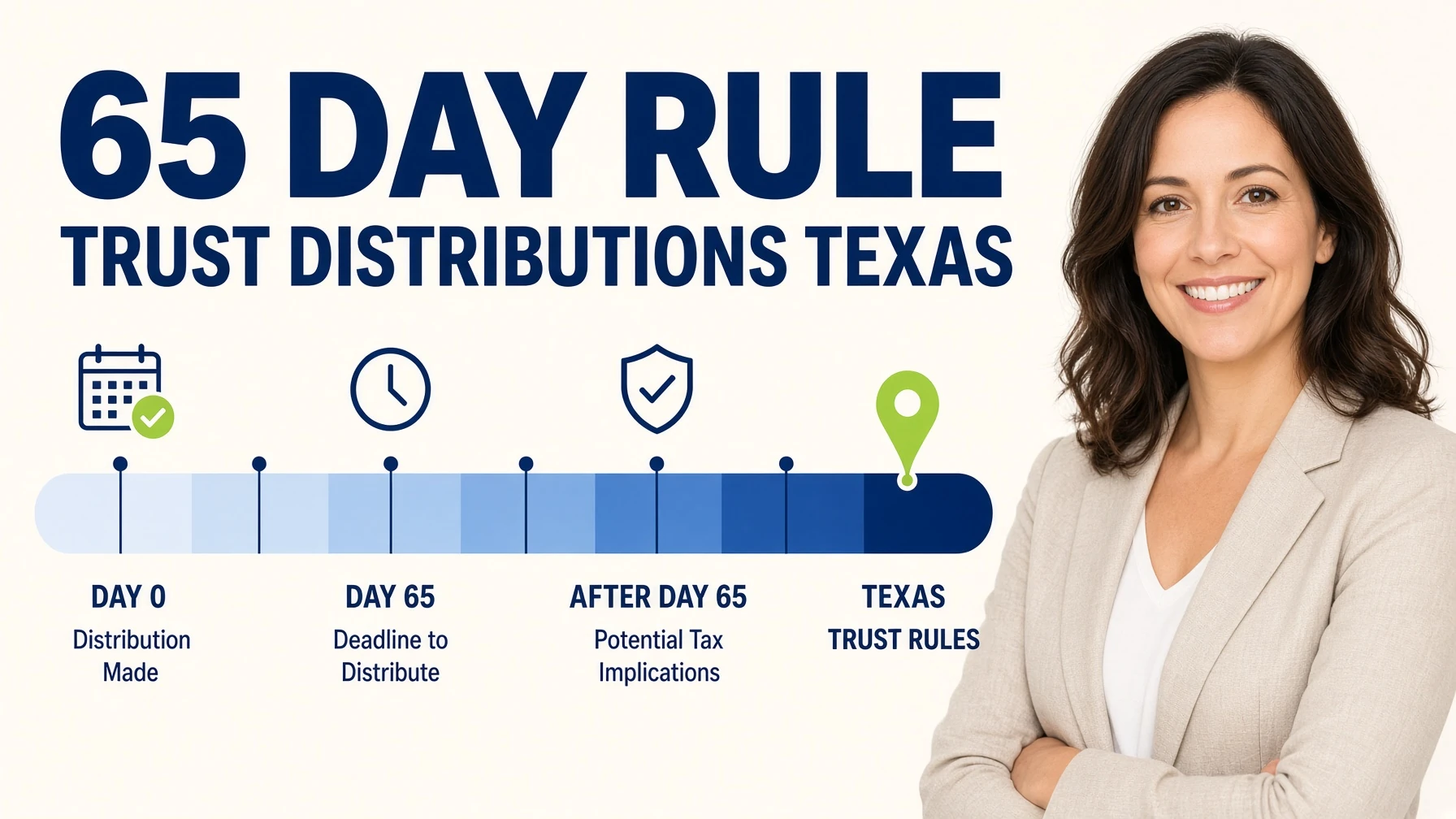
The 65-day rule fixes the timing. Under the Section 663(b) election, a trustee can choose to treat distributions made within the first 65 days of the new year as if they were made on the last day of the prior year. In plain terms, you get a look at the closed year's actual income, then decide, in the new year, to push some of it out to beneficiaries and have it count against last year's return. It turns a deadline you already missed into one you can still hit.
This carries the income out to the beneficiaries through the trust's distribution deduction, and each beneficiary reports their share on a Schedule K-1 and pays tax at their own rate.
The deadline you're racing
The window is exactly what the name says: 65 days after the tax year ends. For a calendar-year trust, that lands on or around March 6 of the following year. Distributions made by that date can be elected back to the prior year; distributions made on March 7 cannot.
That short runway is the whole reason timing matters here. If you're a trustee and last year's trust return isn't filed yet, you may still have room to act, but only if you move before the 65-day window closes. Once it does, the prior year's tax treatment is fixed.
In practice, the smart move is to look at the trust's numbers in January or early February, not to wait until the return is due in April. By April the distribution window is long closed. Trustees who treat the 65-day rule as a filing-season task tend to discover it as a missed opportunity rather than use it as a tool.
A worked example
Say a non-grantor trust retained $50,000 of investment income last year, and the beneficiary is in the 22% bracket. Here's the difference the election makes:
| Trust keeps the income | Trust distributes it (65-day election) | |
|---|---|---|
| Who pays the tax | The trust | The beneficiary |
| Rate applied | Top trust rates (37% plus 3.8% NIIT, reached fast) | The beneficiary's rate (often 12% to 22%) |
| 2026 top-rate threshold | About $16,000 of taxable income | The beneficiary's individual brackets |
| Rough tax on $50,000 | Well over $18,000 | Around $11,000 |
The exact figures depend on the specifics, so treat those as illustrative rather than a promise. But the direction is the point: moving that $50,000 to a lower-bracket beneficiary can save the family thousands, and the 65-day rule is what lets you make that call after the year is already over.
Two things are worth understanding about how this works underneath. First, the income keeps its character as it flows out: interest is still interest in the beneficiary's hands, qualified dividends stay qualified dividends, and so on. Second, the amount you can carry out is tied to the trust's distributable net income, or DNI, which is essentially the pool of income available to be taxed to beneficiaries. You can't distribute past that pool to manufacture a deduction. The election shifts income that genuinely existed; it doesn't create a paper loss.
How to make the election, and which trusts qualify
The election is made on the trust's Form 1041 for the year the distributions relate back to, by checking the 663(b) box on the return. You make it when you file (including on extension), but the distribution itself has to actually happen within the 65-day window. Two separate clocks: money out by roughly March 6, election made on the return.
A few conditions matter. The election applies to complex trusts and to estates, not to simple trusts (which are already required to distribute all their income) or grantor trusts (whose income is taxed to the grantor anyway). The amount you can elect is capped, generally at the greater of the trust's income or its distributable net income for the year, reduced by amounts already distributed. And once made for a given year, the election is irrevocable, so it's worth running the numbers before you commit.
This is also why the distribution decision shouldn't be made in a vacuum. Pushing income to a beneficiary only helps if that beneficiary is actually in a lower bracket and the trust document permits the distribution. A trustee also has to weigh the non-tax side: distributing money changes what stays in the trust for the future.
What Texas changes
Not much, and that's good news. Texas has no state income tax, so there's no state-level trust return and no state tax to layer into the calculation. The 65-day rule is a purely federal strategy, and it applies to a Texas trust exactly as it would anywhere else.
What Texas doesn't change is the value of acting. The federal savings from shifting income out of the compressed trust brackets are the same here as in any state, and the deadline is just as firm.
Racing the 65-day window?
We'll model the distribution for each beneficiary and confirm the Section 663(b) election on the Form 1041 before early March.
The Bottom Line
If a trust closed the year holding income, you probably haven't missed your chance to lower the tax, but you're on a clock. The 65-day rule, the Section 663(b) election, lets a trustee treat distributions made in roughly the first 65 days of the new year as prior-year distributions, moving income from the trust's top-bracket rates to beneficiaries who are usually taxed far less. Make the distribution by about March 6, then make the election on the Form 1041.
Because the election is irrevocable and the math depends on each beneficiary's situation, this is worth running with a CPA before the window closes. If you're a trustee weighing a year-end distribution, that's part of what our team handles in year-round tax planning for Houston-area families and their trusts.