

Last updated: October 10, 2026
Most owners do not decide to do their own bookkeeping. They start the business, do it themselves because there is nobody else, and then one Tuesday at eleven at night, three months behind and staring at a bank feed, they start pricing alternatives.
If that is where you are, the comparison you need is not the one the vendors publish. Each of the three options has a visible price and a second cost underneath it, and the second one is usually bigger. Here is the whole arithmetic.
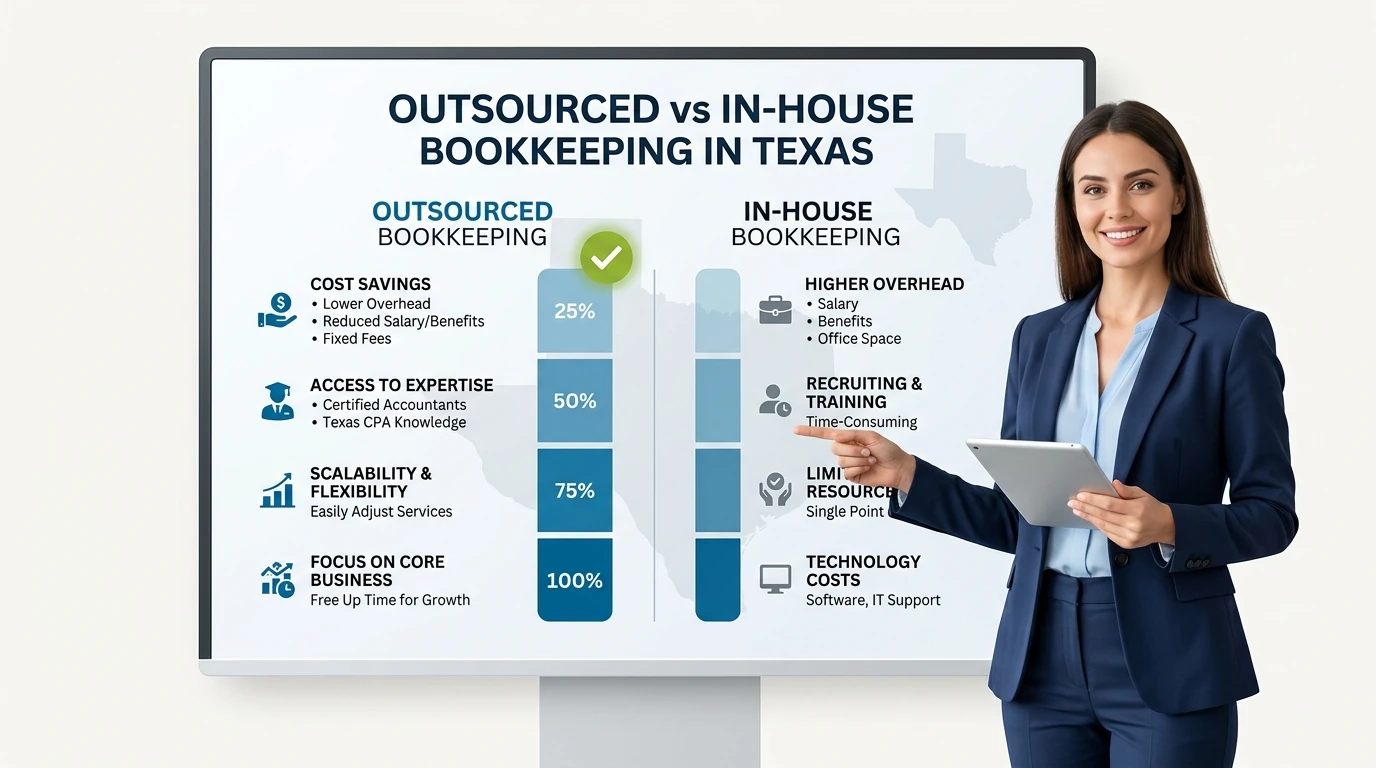
The three models
| DIY | In-house hire | Outsourced | |
|---|---|---|---|
| Who does the work | You, after hours | An employee or part-timer | An outside firm |
| Visible cost | Software only | Salary | Monthly fee |
| What you also carry | Your time, and the error risk | Payroll taxes, benefits, software, training, coverage | Onboarding, and the quality of the firm you chose |
| Scales with volume | Badly | Up to one person's capacity | Yes, by repricing |
| Someone reviews the work | No | Depends who you hire | Yes, if the firm is set up that way |
| Breaks when | You get busy | They quit or go on leave | You picked the wrong firm |
Notice the DIY row has the lowest visible cost and the only "no" on review. That combination is the whole problem with it.
What DIY actually costs
Software for a small business runs modestly, and that is the number owners anchor on. Two other costs sit underneath it.
The first is your time, at the rate your time is actually worth. Not minimum wage, and not what you would pay a bookkeeper. If an hour spent on your business generates revenue, or wins a client, or is the hour you were going to spend with your family, that is the rate. Count the hours honestly: data entry, reconciliation, chasing receipts, fixing what you miscategorized last month, and the hour you lose to dread before starting. Multiply. For most owners the figure lands well above what outsourcing the same work would cost, which is the part the software price hides.
The second is what the errors cost. DIY books have nobody reviewing them, so mistakes persist until something forces them out, usually a tax return or a loan application. A year of transactions in the wrong accounts is a cleanup project. A missed deduction is money gone. An asset expensed instead of capitalized can close off depreciation treatment you cannot retroactively claim. These are not hypothetical risks for a careful person; they come from not knowing which questions the return will ask, which is a different skill from being organized.
DIY is still the right answer sometimes. If you are pre-revenue, or running a handful of transactions a month, paying anyone is premature. The trigger to re-evaluate is volume and complexity rather than revenue.
What an in-house hire actually costs
Salary is roughly two-thirds of it - the rest is the loading.
| Cost component | What it adds |
|---|---|
| Base salary | The visible number |
| Employer FICA | 7.65% of wages, the employer share of Social Security and Medicare |
| Federal unemployment | 6.0% on the first $7,000 of wages, usually 0.6% after the state credit |
| State unemployment | Texas rate varies by employer, assessed on a wage base |
| Benefits | Health coverage, any retirement match, paid time off |
| Software and equipment | Accounting software, a computer, a seat for anything else they need |
| Training and ramp | Months to productive, plus whatever they need to learn your business |
| Recruiting | Time, or a fee |
| Coverage | Who does it when they are out, and who does it when they leave |
A common planning heuristic puts fully loaded employee cost at roughly 1.25 to 1.4 times base salary. Treat that as a rough multiplier for budgeting rather than a precise figure, and build the real number from the rows above for your own situation.
Two risks do not show up as line items. One is that nobody checks the work: a single bookkeeper with no reviewer is the same no-review problem as DIY, with a salary attached. The other is concentration. When one person holds all the knowledge of how your books are kept and they resign, you discover what was never written down.
In-house starts making sense when volume is high enough to keep someone genuinely busy, and it works best paired with outside review rather than standing alone.
Outsourcing, and the two kinds of it
Our monthly bookkeeping runs $250 to $5,000 per month, priced on transaction volume, how many accounts need reconciling, how many entities you run, and whether there is inventory or multi-state activity. Payroll is separate at $80 a month plus $10 per employee per month, and tax preparation is its own engagement at $500 to $4,000. The pricing guide walks through what moves a business across that range.
The number matters less than this: "outsourced" covers two genuinely different purchases.
| Software-first platforms | CPA-led firm | |
|---|---|---|
| Built around | A platform, with bookkeepers behind it | A licensed practice |
| Monthly output | Clean, consistent | Clean, consistent |
| Tax strategy | Thin or absent | Part of the relationship |
| IRS representation | No | Yes |
| Who knows your file | An account manager, often reassigned | A named CPA |
| Attest work if a lender asks | No | Yes |
The monthly bookkeeping from a national platform is frequently fine. The gap is everything after it. In April, nobody is deciding that your chart of accounts needs to support an S-corp election. If a notice arrives, nobody there can speak for you. And the person who knew your business last year has moved to another account.
One thing to know about how we work: if you want tax preparation only, keep whatever arrangement you have and we will work from what you give us. If you want planning and a year-round relationship, the bookkeeping is part of that engagement. Planning is only as good as the data underneath it, so we keep the books to the same standards the return is built on rather than waiting on a third party for answers. For an owner coming from DIY there is nothing to displace, which makes this the easiest version of that transition.
"How do I trust a CPA I'll never meet in person?"
This sits behind most outsourcing hesitation, so it deserves a direct answer rather than reassurance.
94.6% of our clients work with us virtually, 191 of 202. The number that should settle it: 161 of our 172 Greater Houston clients are close enough to drive over and do not. They are not remote by necessity - they work this way because it beats a meeting, and the ones nearby chose it alongside the ones in other states.
In practice that means documents move through secure exchange rather than email attachments. Video calls happen when a conversation is actually warranted. And you reach a named CPA directly instead of a ticket queue. We have been in practice since 2007. Clients sit across 9 states and 4 countries, and our longest relationships run past eight years. In-person meetings are not refused when they make sense; they are just not a requirement, and most clients stop wanting them within a few months.
Which one fits where you are
| Your situation | Usually fits |
|---|---|
| Pre-revenue, or a few dozen transactions a month | DIY, with a plan to revisit |
| Growing, under a few hundred transactions, no employees | Outsourced bookkeeping |
| Employees, inventory, or two entities | Outsourced, CPA-led |
| High volume plus operational work beyond the books | In-house for the day-to-day, with outside CPA oversight |
| Behind, and unsure how far | A scoped catch-up project before choosing an ongoing model |
The last row comes before the decision, not after it. Choosing an ongoing arrangement while the books are months behind means pricing a project nobody has measured.
Not sure which model fits your volume?
Tell us your accounts, monthly transaction count, and how current the books are, and we will lay out what DIY, a hire, and outsourcing would each really cost you.
The Bottom Line
The published price is the smallest part of this comparison. DIY looks nearly free and costs you the hours at whatever your time is actually worth, plus the errors nobody is reviewing for. An in-house hire costs well above the salary once employer FICA at 7.65%, unemployment tax, benefits, software, ramp, and coverage are counted, and a single bookkeeper with no reviewer has the same blind spot DIY does. Outsourcing has the most honest number because there is only one of it. Just note that "outsourced" splits into a software platform with bookkeepers behind it and a licensed CPA practice, and only one of those can plan your taxes or speak for you to the IRS. Pick on volume and complexity rather than revenue, and if you are behind, scope the catch-up before you price the ongoing work.