
Last updated: May 26, 2026
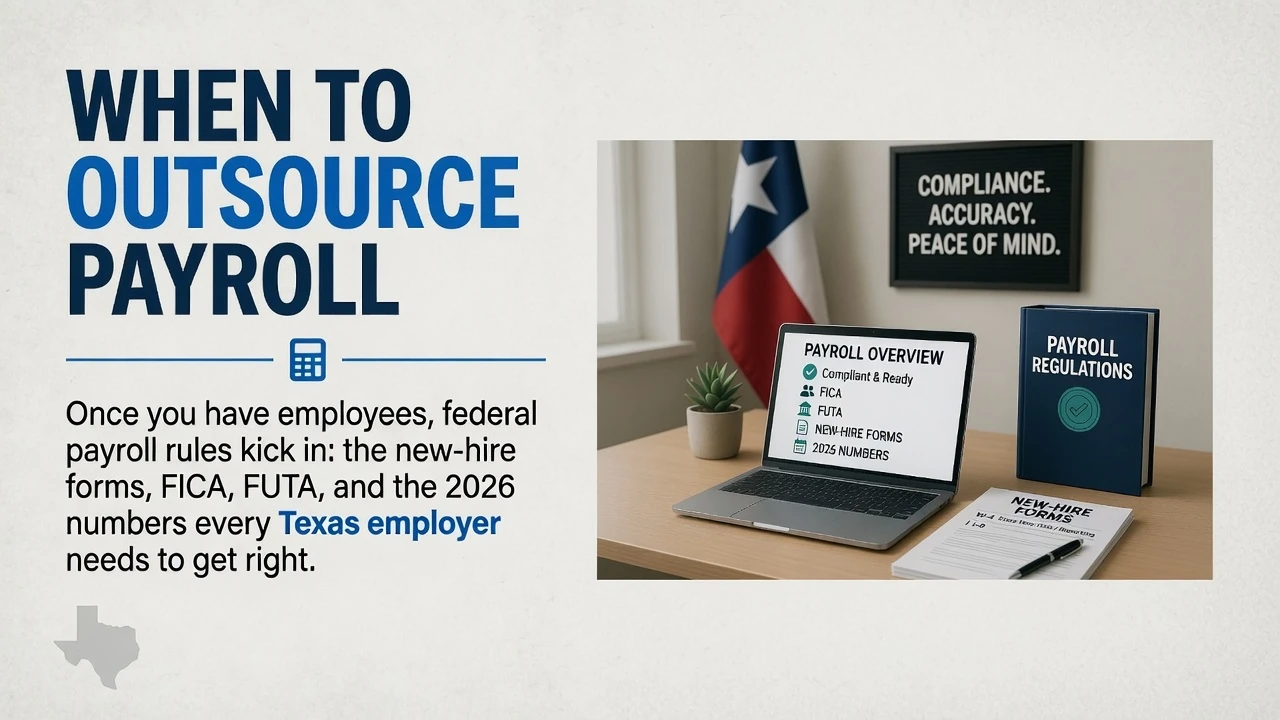
Payroll is the Pandora's box of small business ownership. Open one small corner and a rush of tax law, labor rules, and local, state, and federal requirements comes pouring out. Most owners start running payroll themselves for a simple reason: with one or two employees, it was a hassle but not worth paying someone else to handle. Then the business grew, and one day a plain envelope from the IRS shows up saying you didn't pay your payroll taxes correctly. That's usually the moment owners wish they'd outsourced sooner.
The goal is to make that decision before the scary letter, not after. So here are the warning signs that payroll has quietly outgrown your desk, and what happens when you hand it off.
Sign one: payroll changes every pay period
If no two payrolls look the same, you're spending real time and inviting mistakes. Variable-hour employees, part-time workers, and a steady stream of new hires during a growth phase all mean you're recalculating from scratch every cycle. That's exactly the kind of repetitive, detail-heavy work where a small error compounds quietly until it surfaces as a penalty.
Sign two: you have employees in more than one state
The day your business crosses state lines, the complexity jumps. Tax and labor laws vary from state to state, and sometimes from one locality to the next. Knowing each state's withholding rules, unemployment tax, and filing requirements, and keeping up as they change, can be a full-time job you don't have. This is one of the clearest signals that payroll has moved beyond something you should be doing between other tasks.
Sign three: you've crossed 50 employees
Once you reach 50 full-time employees, including full-time-equivalents, the Affordable Care Act adds a whole new reporting layer. As an Applicable Large Employer, you have to show you offered affordable health coverage and track each employee's hours, eligibility, offer of coverage, and the months it applied, then report it on the 1095-C forms. Calculating all of that by hand, without software built for it, is daunting. For this reporting alone, a payroll vendor often pays for itself.
In-house vs. outsourced: where the line usually falls
There's no universal cutoff, but the tradeoff tends to tip along a few predictable lines:
| Doing it yourself can still work when... | It's probably time to outsource when... |
|---|---|
| You have a few employees with stable hours | Payroll changes nearly every pay period |
| Everyone works in a single state | You've hired across state lines |
| You're well under 50 employees | You've crossed 50 full-time employees and ACA applies |
| You have a reliable process and the time | You've already gotten an IRS notice or missed a deadline |
If you're reading the right-hand column and nodding, the question isn't really whether to outsource. It's when.
What switching actually looks like
Handing off payroll is less disruptive than most owners fear. In theory, the cleanest time to switch is the start of your fiscal year, when the prior year's books are closed and everything is fresh, but there's no fixed season for it.
Every provider runs an onboarding process. You supply basic information about your company and your employees, and the vendor does a test run so you can validate the data before anything goes live. Once it checks out, your next pay date becomes your first official payroll with the new provider. No transition is completely smooth, so plan to double-check the first run carefully: the data, the check amounts, employee withholdings, and your estimated tax payments. After that, the provider takes over tracking your tax payments and withholdings and handling year-end paperwork like W-2s. Some vendors also add extras, such as online benefit enrollment that lets employees manage their own changes during life events and open enrollment.
What Texas changes
Texas removes one piece of the puzzle: with no state income tax, there's no state income tax withholding to run. But that doesn't make payroll simple, and it doesn't lower the stakes on the federal side or with the Texas Workforce Commission for unemployment tax. If anything, the "no state income tax" reputation lulls some Texas owners into underestimating payroll right up until a notice arrives.
Not sure it's time to hand off payroll?
We'll look at your headcount, multi-state exposure, and ACA reporting, then tell you honestly whether outsourcing pays off for your business.
The Bottom Line
The right time to outsource payroll is before it becomes a problem, not after the IRS letter. Watch for the signs: payroll that changes every pay period, employees in more than one state, and crossing 50 full-time employees into ACA reporting. Any one of them is a signal that payroll has grown past what you should be handling between everything else you do. Switching is a straightforward onboarding process, and it moves the ongoing tracking, deposits, and year-end reporting off your plate.
If you're weighing whether it's time, or you want a second opinion on how much risk your current setup carries, that's part of what our team handles in year-round payroll and compliance work for Houston-area business owners.