
Last updated: April 21, 2026
When you work for someone else, retirement saving is handled for you. There's a 401(k) in the onboarding packet, and you check a box. When you own the business, nobody sets one up. So a lot of profitable owners get years into running a successful company with no retirement plan and a big tax bill they could have partly avoided.
The good news is that the accounts available to business owners let you save far more than a regular employee can, while cutting your taxable income in the process. The two that matter most for a Houston-area owner are the Solo 401(k) and the SEP IRA. This post covers how they differ, how much you can put away in 2026, and what happens if you need the money before you're supposed to.
Why owners need to build their own plan
A retirement plan for a business owner does two jobs at once. It builds your own retirement, and it lowers your taxes now, because contributions come off your taxable income. For a profitable owner, that second part is often the immediate motivator: a five-figure contribution can meaningfully cut what you owe in April.
The catch is that you have to set it up yourself, and the choice between plan types actually matters. Pick the wrong one and you either leave contribution room on the table or take on paperwork you didn't need. For most owners with no employees, it comes down to two options.
Solo 401(k) vs. SEP IRA: the real difference
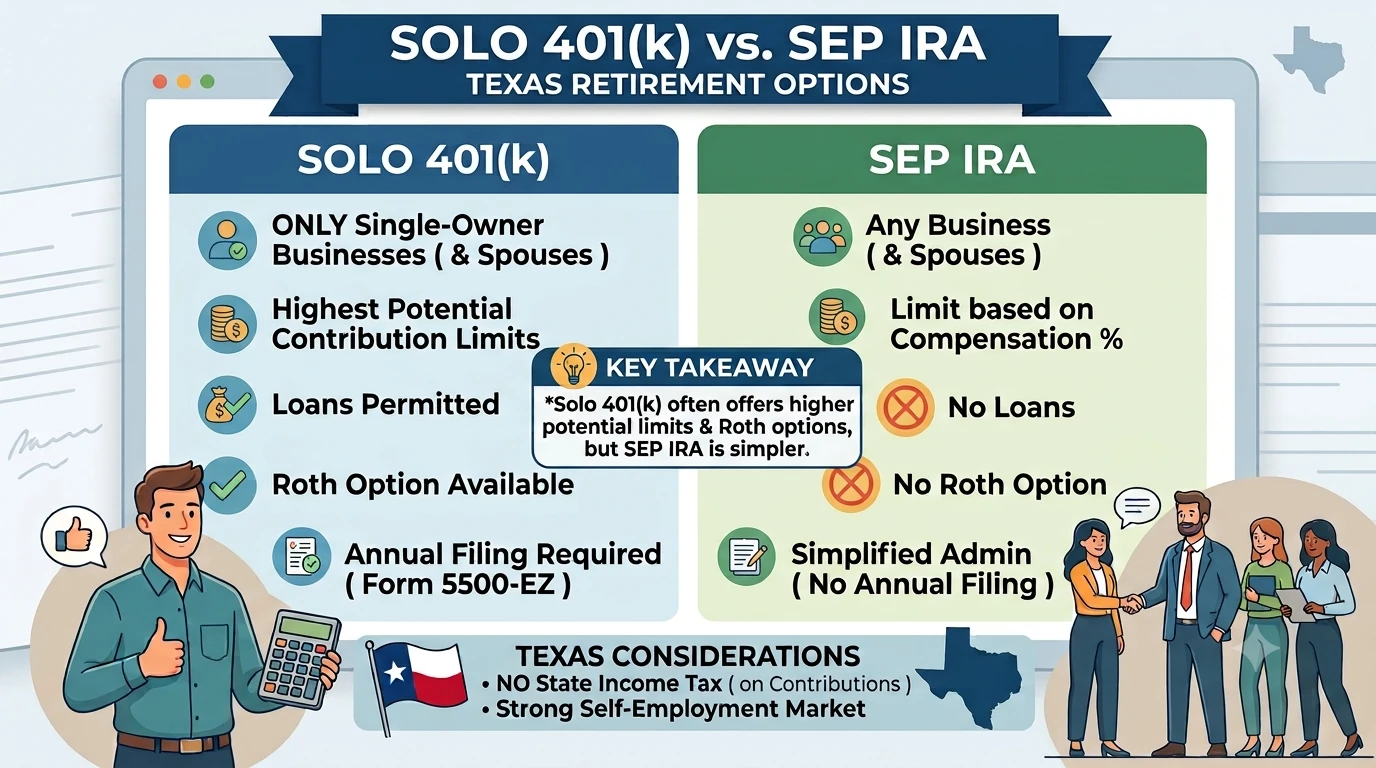
A Solo 401(k) is a 401(k) for a business with no employees other than you and possibly your spouse. A SEP IRA is a simpler employer-funded account that works whether or not you have staff. They sound similar and they're taxed similarly going in, but they behave very differently.
Here's the side-by-side for 2026:
| Feature | Solo 401(k) | SEP IRA |
|---|---|---|
| Who contributes | You, as both employee and employer | Employer only |
| 2026 employee deferral | Up to $24,500 | None |
| 2026 employer contribution | Up to 25% of compensation | Up to 25% of compensation |
| 2026 combined maximum | $72,000 (plus catch-up) | $72,000 |
| Catch-up at 50+ / ages 60 to 63 | Yes: +$8,000 / +$11,250 | No |
| Roth option | Yes | Rarely available |
| Loans allowed | Yes, up to $50,000 | No |
| Works if you have employees | No, owner and spouse only | Yes, but you must fund them too |
| Setup deadline | Plan established by December 31 | By your tax deadline, extensions included |
The single biggest difference is that a Solo 401(k) lets you contribute as both the employee and the employer, while a SEP only gives you the employer piece. That employee deferral, up to $24,500 in 2026, is why the Solo 401(k) usually lets you save more, especially at moderate income levels.
How much you can actually put in
The numbers get real when you run them against actual income, so here's the math both accounts use.
With a SEP IRA, you can contribute up to 25% of your compensation, capped at $72,000 for 2026. That's the whole formula. If your business pays you $100,000, your SEP contribution tops out around $25,000.
With a Solo 401(k), you stack two contributions. First, the employee deferral: up to $24,500 of your compensation. Then, on top of that, the employer profit-sharing piece: up to 25% of compensation. The combined total can reach $72,000 in 2026, and if you're 50 or older you can add another $8,000, or $11,250 if you're between 60 and 63, on top of that ceiling.
Take that same $100,000 of compensation. The SEP gets you about $25,000. The Solo 401(k) gets you the $24,500 deferral plus roughly $25,000 in profit-sharing, close to $49,500, nearly double. Only once your income climbs high enough that 25% alone hits the $72,000 cap do the two accounts land in the same place. For most owners short of that, the Solo 401(k) wins on raw contribution room, and it adds Roth, loans, and catch-up on top.
One 2026 wrinkle worth flagging: if you earned more than $150,000 in wages from the business in 2025, your catch-up contributions now have to go in as Roth rather than pre-tax. It doesn't reduce how much you can put away, but it changes the tax treatment of the catch-up portion.
Your entity changes the math
Your business structure changes what counts as "compensation," and therefore how much you can contribute. Generic retirement articles skip this.
If you're a sole proprietor or single-member LLC, contributions are based on your net self-employment income, and the effective employer rate works out closer to 20% than 25% once the self-employment tax adjustment is factored in. If you run an S corporation, contributions are based on your W-2 wages, which means the salary you set directly caps your retirement contributions. The 25% profit-sharing is 25% of your W-2 salary, not your total business profit.
That creates a real tension for S-Corp owners. A lower salary saves payroll tax, but it also shrinks the compensation your retirement contribution is built on. Set the salary too low and you cap your own retirement savings. This is one more reason the reasonable-salary decision for an S-Corp deserves actual thought rather than a guess, because it ripples into more than just payroll.
Deadlines that matter
Timing is where good intentions die, and the two accounts have different clocks.
A SEP IRA is forgiving. You can open and fund it right up to your tax filing deadline, including extensions, which means you can decide in the following year, once you know your actual profit, and still make a contribution for the prior year. That flexibility is one of the SEP's genuine advantages.
A Solo 401(k) is stricter on setup. The plan generally has to be established by December 31 of the tax year you want it to count for, even though you have until the tax deadline to actually fund parts of it. So if you're eyeing a Solo 401(k) for this year's taxes, the move is to get the plan open before year-end, not to remember it in April. Miss that window and the SEP may be your only option for the prior year.
When you can touch the money before 59½
These accounts are built for retirement, so the system nudges you to leave the money alone. Generally, taking money out before age 59½ means income tax plus a 10% early withdrawal penalty. But the penalty has a long list of exceptions, and knowing them removes the main fear that keeps owners from contributing in the first place.
Some of the exceptions that waive the 10% penalty include total disability, unreimbursed medical expenses above 7.5% of your income, up to $5,000 for a birth or adoption, a substantially equal periodic payment plan (sometimes called 72(t)), and certain emergencies added by recent law. A few are specific to the account type. With a 401(k), the "rule of 55" lets you take penalty-free withdrawals from that plan if you leave the business in or after the year you turn 55. IRAs, on the other hand, add their own exceptions like a first home purchase up to $10,000 and qualified higher-education costs.
There's also a middle path that isn't a withdrawal at all. A Solo 401(k) can allow loans of up to $50,000 or half your balance, whichever is less, which you pay back to yourself with interest. It's not free money, but it beats a taxable, penalized distribution when you need cash temporarily. The takeaway isn't that you should plan to raid the account. It's that the money isn't as locked away as people fear, so "what if I need it" shouldn't stop you from funding it.
Not sure which plan fits your business?
We'll run your actual 2026 contribution numbers and coordinate them with your entity and salary so you claim the biggest deduction you're entitled to.
The Bottom Line
If you own a profitable business and haven't set up a retirement plan, you're leaving both savings and a tax deduction unclaimed. For most owners with no employees, a Solo 401(k) allows the largest contribution, up to $72,000 in 2026 plus catch-up, because you contribute as both employee and employer, and it adds Roth, loans, and catch-up options a SEP doesn't. A SEP IRA is simpler and can be funded up to your tax deadline, which makes it a solid fallback, especially if you missed the December 31 setup window for a Solo 401(k). Your entity type changes the math, particularly for S-Corp owners whose salary caps the contribution. And if you're worried about locking the money away, the early-access exceptions and 401(k) loan option give you more flexibility than most people realize.
If you want help choosing the right plan for your business, running your actual contribution numbers, or coordinating it with your S-Corp salary, that's exactly the kind of planning our team does with Houston-area owners, ideally before year-end rather than at filing time.