
Last updated: April 7, 2026
Most people think a health savings account is just a place to park money for doctor visits. It is that, but treating it only as a medical account misses what makes it interesting: it's the most tax-advantaged account in the entire tax code, and business owners are among the people best positioned to use it. If you have a high-deductible health plan and you're only using your HSA as a glorified checking account for copays, you're skipping the actual value.
There's also a catch that trips up S-Corp owners specifically, one that generic personal-finance articles never mention because they're not written for people who own the business. We'll get to that, because it changes how you should claim the deduction.
What the triple tax advantage actually means
The HSA is the only account that gets a tax break at all three stages. That's what "triple tax advantage" means, and it's not marketing.
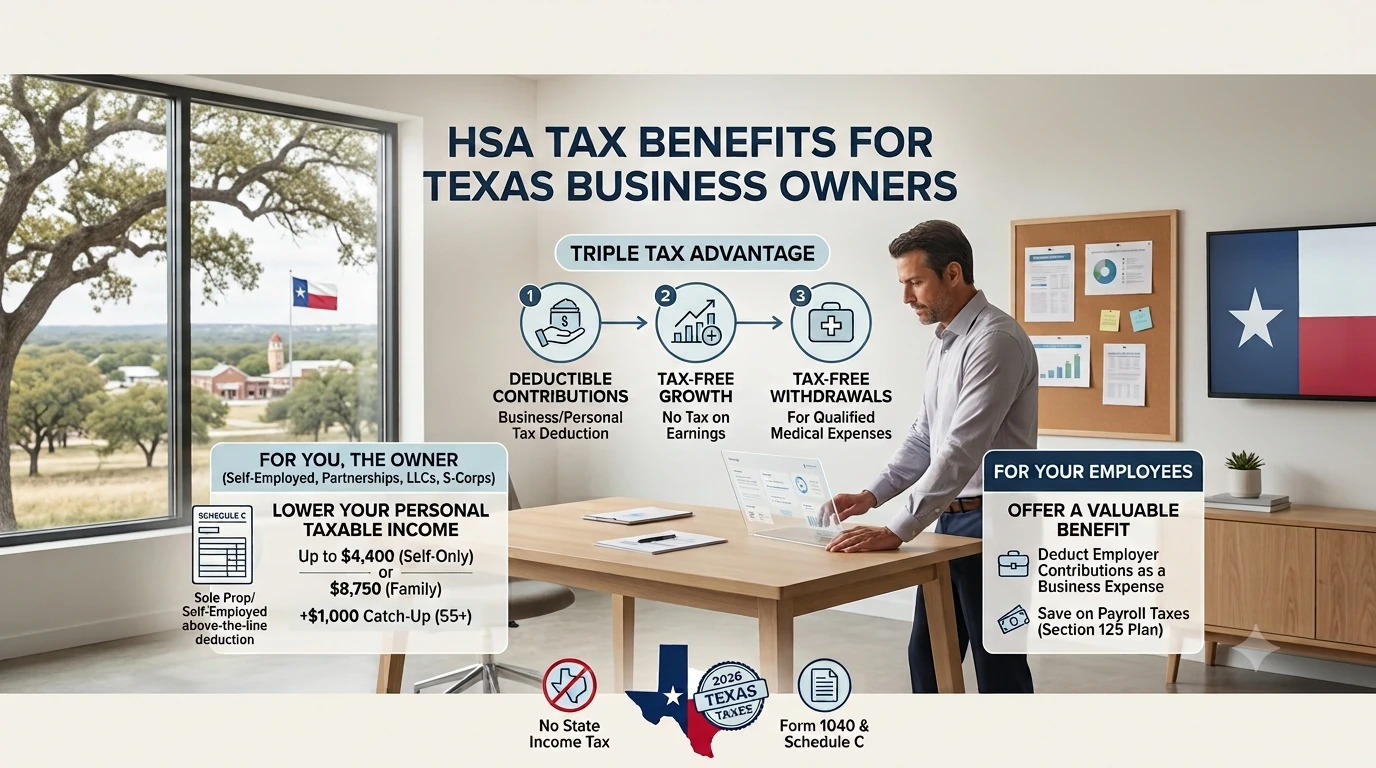
Money goes in tax-deductible. Contributions reduce your taxable income the year you make them. The money grows tax-free. You can invest an HSA the same way you invest a retirement account, and the growth isn't taxed. And the money comes out tax-free when you spend it on qualified medical expenses. No other account does all three. A traditional 401(k) taxes you on the way out. A Roth taxes you on the way in. The HSA does neither, as long as the money goes toward health costs.
One underrated detail: the contribution deduction is above the line, which means you get it even if you take the standard deduction. You don't have to itemize to benefit, which is where a lot of people wrongly assume they're excluded.
The stealth retirement account nobody mentions
This is the part that turns an HSA from a health account into a genuine wealth tool. You are not required to spend the money the year you contribute it, or ever, really.
You can pay this year's medical bills out of pocket, leave the HSA invested, and let it compound for decades. Save the receipts. Years later, you can reimburse yourself tax-free for those old expenses, or just let it keep growing. And once you turn 65, the HSA loosens up entirely: you can withdraw the money for any reason, not just medical, and it's simply taxed as ordinary income, exactly like a traditional IRA. Before 65, non-medical withdrawals get taxed plus a 20% penalty, so the flexibility really kicks in at retirement age.
So an HSA is effectively a medical-expense account that doubles as a retirement account with better rules than either a 401(k) or an IRA. For a healthy business owner who can afford to pay small medical bills out of pocket now, maxing the HSA and investing it is one of the quietest, most efficient tax moves available.
The 2026 numbers you need
To use an HSA, you have to be covered by a qualifying high-deductible health plan (HDHP), and both the plan and your contributions have to hit specific numbers. Here's what applies for 2026:
| 2026 figure | Self-only coverage | Family coverage |
|---|---|---|
| HSA contribution limit | $4,400 | $8,750 |
| Catch-up contribution (age 55+) | +$1,000 | +$1,000 |
| HDHP minimum deductible | $1,700 | $3,400 |
| HDHP out-of-pocket maximum | $8,500 | $17,000 |
A few things to read off that table. Your health plan only counts as an HDHP if its deductible is at least the minimum shown and its out-of-pocket max stays under the ceiling shown. If your plan qualifies, you can contribute up to the limit for your coverage type, plus the extra $1,000 if you're 55 or older. And the contribution limit counts everything that goes in from all sources combined, so if your business puts money into your HSA, that reduces how much you can add yourself.
You also can't be enrolled in Medicare or be claimed as someone's dependent, and you can't have disqualifying other coverage. For most working business owners under 65, none of that is an obstacle.
How the tax break works depends on your entity
This is where business owners diverge from regular employees, because how you get the deduction depends on how your business is structured. The account is the same; the mechanics of claiming it are not.
If you're a sole proprietor, a single-member LLC, or a partner, you're not a W-2 employee of the business. You contribute to your HSA with personal money and take the deduction above the line on your Form 8889 with your 1040. Clean and simple, but you don't get to run it through the business pre-tax.
If you own a C corporation and take a salary, you can contribute through a cafeteria plan with pre-tax payroll dollars, which saves both income tax and payroll tax. That's the most tax-efficient version, because it dodges the payroll tax that the personal-deduction route doesn't.
If you own an S corporation and hold 2% or more of it, you're in the special case, and it's the one worth slowing down for.
The S-Corp 2% shareholder trap
If you own more than 2% of an S corporation, the IRS treats you differently from your own employees for benefits, and the HSA is a prime example. You can't participate in the company's cafeteria plan, so you can't make pre-tax payroll contributions the way a regular employee can.
Here's how it works. When your S-Corp contributes to your HSA, that amount has to be added to your W-2 wages as taxable income for income tax purposes. Then you turn around and deduct the same amount above the line on your personal return. For income tax, it roughly washes out, so you still get the deduction. What you don't get is the payroll tax savings, and you can't route it pre-tax through the company plan the way your non-owner employees can.
The practical takeaway: an S-Corp owner absolutely should still use an HSA, because the triple tax advantage and the deduction are all intact. You just claim it on your personal return rather than expecting pre-tax treatment through payroll. Owners who don't understand this either skip the HSA thinking they can't benefit, or set up the payroll wrong and create a mess. If you've elected S-Corp status, this is one more detail that has to be handled correctly, alongside your reasonable salary and the rest of the payroll setup.
What Texas changes
Texas keeps this simple, mostly by staying out of the way. With no state income tax, the HSA deduction only reduces your federal tax, and there's no separate Texas treatment to track. That's not a downside, it just means the value is federal.
The payroll tax angle still matters regardless of state. For a C-corp owner or a regular employee contributing pre-tax through a cafeteria plan, the federal payroll tax savings apply whether you're in Texas or anywhere else. For a self-employed Texan or an S-Corp owner claiming the deduction personally, the benefit is federal income tax savings plus the tax-free growth and withdrawals, which are the same everywhere. Texas just doesn't add a second layer of tax to work around.
Not sure how to claim your HSA deduction?
Whether you're a sole proprietor, an S-Corp owner, or somewhere in between, we'll make sure your 2026 HSA is set up and claimed the right way.
The Bottom Line
An HSA is the most tax-advantaged account most business owners aren't fully using. Contributions are deductible, growth is tax-free, and qualified medical withdrawals are tax-free, and after 65 it works like an IRA for anything else. For 2026, you can contribute $4,400 for self-only coverage or $8,750 for family, plus $1,000 more at age 55 and up, as long as you're on a qualifying high-deductible plan. The one real trap is for S-Corp owners with a 2% or greater stake: you still get the deduction, but you claim it on your personal return rather than pre-tax through payroll, and setting it up wrong causes problems.
If you're a Houston-area business owner wondering whether your plan qualifies, how much to contribute, or how to handle the S-Corp side correctly, that's a quick conversation with a CPA that tends to pay for itself in the first year's deduction alone.